There is growing interest among students in international training opportunities, particularly in the United States. In a recent survey of 169 UERM medical students conducted early 2026, the majority expressed a strong desire to learn more about international electives, research opportunities, and postgraduate training in the U.S. This highlights a clear need for structured guidance, early exposure, and accessible mentorship to help students navigate these pathways effectively.
The MD program at UERM is a high-density, structured curriculum that integrates foundational sciences, clinical correlation, and early clinical exposure. While clinical enrichment remains beneficial, any additional academic initiative must be carefully designed to complement—not duplicate—the existing curriculum and avoid unnecessary student burden.
Medical school is inherently physically and mentally demanding, requiring sustained academic effort, emotional resilience, and adaptability. Students frequently experience high levels of stress, risk of burnout, and uncertainty regarding future career paths. In this context, strong mentorship and emotional support are essential to student well-being, persistence, and overall success throughout medical training.
UERM is uniquely positioned to respond to these needs through its strong network of alumni physicians practicing in the United States across diverse specialties. These alumni represent a valuable and underutilized resource who can provide mentorship, emotional support, career guidance, and access to international opportunities. Having successfully navigated both medical training and transition to practice abroad, they are well-equipped to guide students through similar academic, professional, and personal challenges.
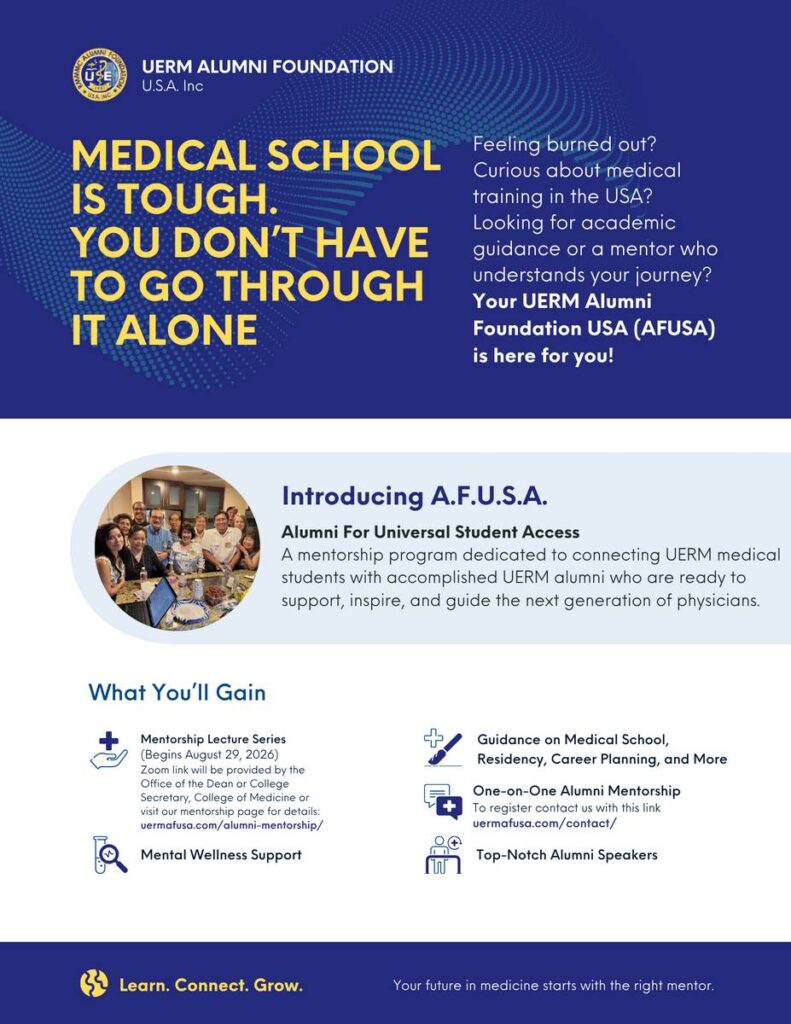
In response, UERM AFUSA proposes a pilot program that prioritizes mentorship, wellness support, career development, and international pathway guidance, with optional, non-redundant clinical enrichment sessions as a supplementary component.
Platform:
Zoom (or equivalent virtual meeting platform)
Session Length:
One (1) hour per session
In addition to individualized student-initiated mentorship, the program will include one (1) hour scheduled and structured Zoom lecture sessions conducted every 1–2 months.
These sessions will focus on high-yield, practical topics aligned with program goals, including:
The scheduled and structured Zoom discussions will be open to all students interested.
Structured, longitudinal mentorship including:
Participants will also engage in scheduled and structured discussion sessions every 1–2 months, reinforcing key topics such as USMLE preparation, residency competitiveness, and research engagement.
Alumni will play a key role in supporting the development of structured international clinical exposure opportunities for UERM medical students.
Specifically, alumni will:
This collaboration aims to help UERM develop sustainable partnerships that will enable future medical students to undertake structured elective rotations in the United States, thereby enhancing global clinical exposure and competitiveness for residency training.
Focused on student well-being and professional development:
To maintain alignment with the existing curriculum:
Focus areas include:
Suggested Session Structure:
Students will:
Alumni will serve as volunteer mentors and facilitators.
They may provide:
Alumni are not expected to replicate formal teaching or perform evaluations.
A curated directory (Schedule E) will be maintained on the official UERM AFUSA website www.uermafusa.com.
Profiles may include:
The UERM AFUSA Alumni–Student Mentorship, Career Development, and Clinical Enrichment Program is a cost-effective and sustainable initiative designed to enhance student development through targeted mentorship, wellness support, and global engagement.
By prioritizing areas where alumni can have the greatest impact—mental health support, U.S. residency guidance, and institutional collaboration—the program aligns with UERM’s academic framework while addressing evolving student needs.
Structured discussion sessions conducted every 1–2 months provide focused, practical guidance on USMLE preparation, residency applications, and research opportunities, while optional clinical enrichment sessions add academic value without duplicating the curriculum.
This pilot initiative aims to strengthen alumni engagement, support student success, and expand UERM’s global academic and professional network.
The following list of ALUMNI have volunteered their time and energy to serve as mentors to UERM Medical Students.
| Eliezer de Leon MD’73 ADS Board Certified Internal Medicine and Acupuncture and Detoxification Former Care Management Director, Corewell Health Systems Michigan |
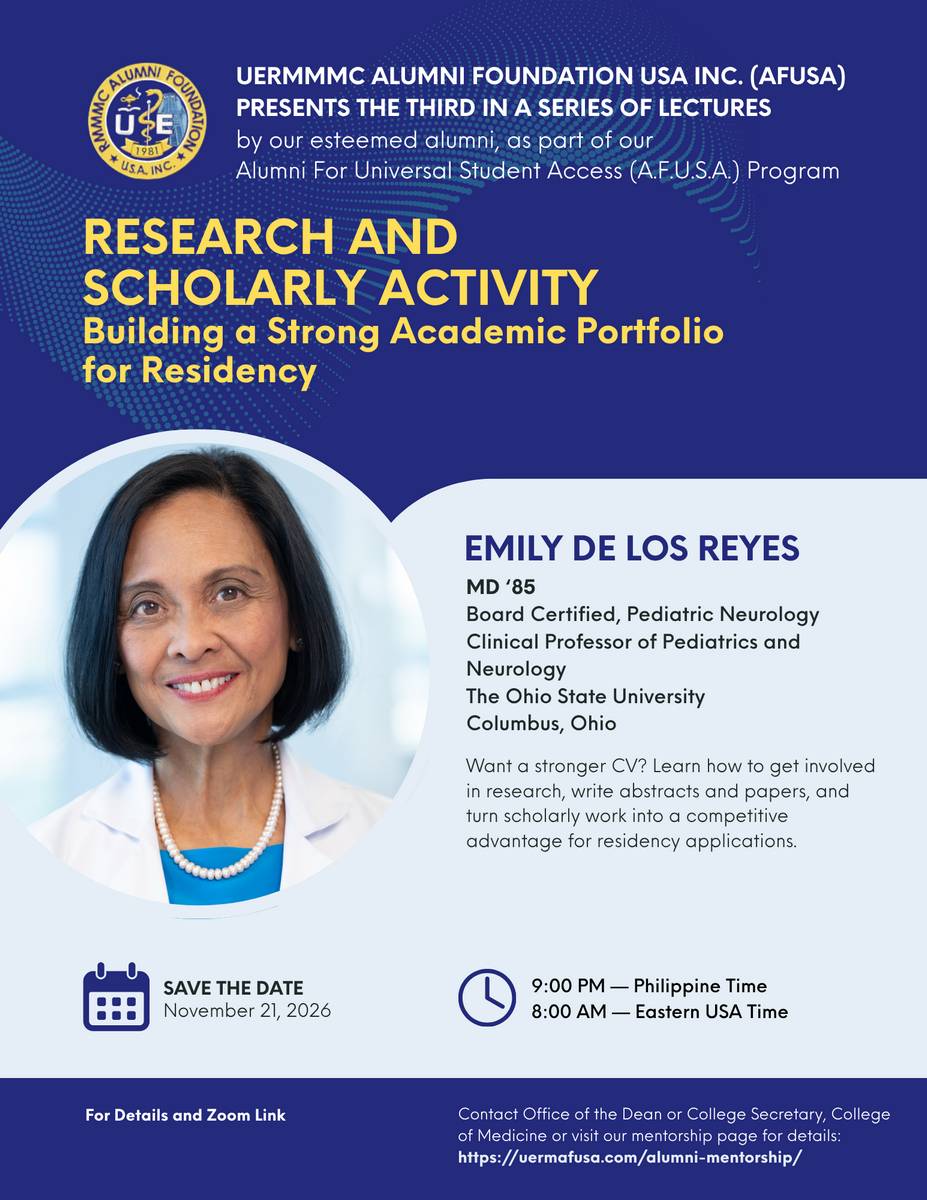
| Emily de Los Reyes MD’85 Board Certified Pediatric Neurology Clinical Professor of Pediatrics and Neurology The Ohio State University School of Medicine Ohio |
| Rommel Aquino MD’85 HMDC Board Certified Family Medicine Board Certified as Hospice Medical Director Michigan |
| Nathalie Bernabe-Quion MD’88 MPH FAAP Associate Professor of Pediatrics Children’s National at Columbia Heights Washington, DC |
| Luven Marie S. Tejero MD ’93 Board Certified Psychiatry Medical Director Lenawee Community Mental Health Michigan |
| Carmen Tapiador MD ’93 Board Certified Pediatric Endocrinology Tennessee |
| Jacqueline Fabello-Gamiao MD ’87 FCCP FAASM Board Certified Endocrinology, Diabetes and Metabolism Fellow, American College of Endocrinology Michigan |
| Michael Gamiao MD ’87 Board Certified Pulmonary, Critical Care and Sleep Medicine Fellow, American College of Chest Physicians Fellow, American Academy of Sleep Medicine Michigan |
| Roy Torcuator MD ’93 Board Certified Neurosurgery Michigan |
| Mario Trance MD’89 Board Certified Internal Medicine Hospitalist, Naples Comprehensive Health Florida |
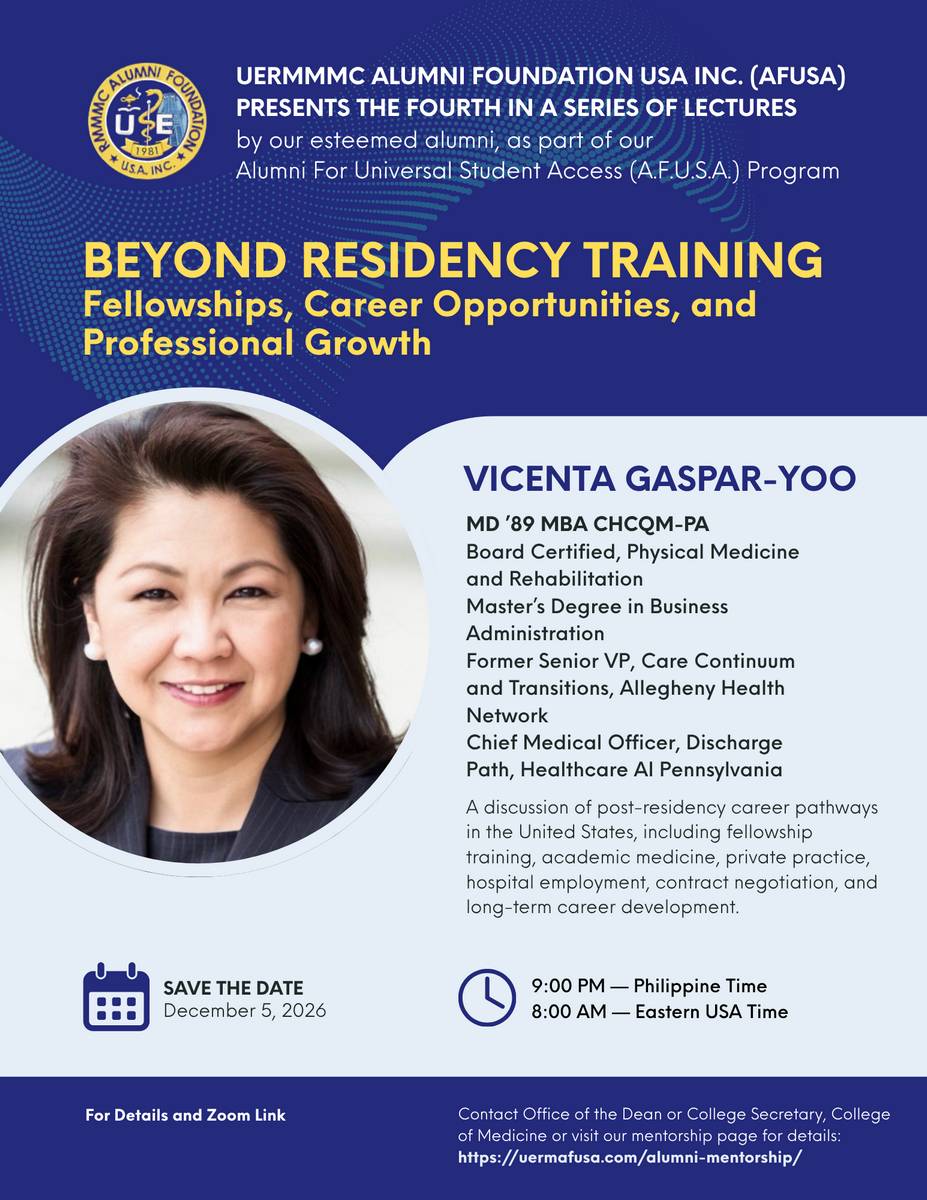
| Vicenta Gaspar-Yoo MD’89 MBA CHCQM-PA Board Certified Physical Medicine and Rehabilitation Master’s Degree in Business Administration Senior VP. Care Continuum and Transitions, Allegheny Health Network Chief Medical Officer, Discharge Path, Healthcare AI Pennsylvania |
| Enrico Esguerra MD ’87 Board Certified Pediatrics Joplin, Missouri |
| Marisha Agana MD ’88 Board Certified Pediatrics Hackley Community Care Muskegon, Michigan Assistant Professor, Michigan State University College of Human Medicine Specialist and Researcher in Childhood Obesity Michigan |
| Pauline Camu-Aquino MD’90 Board Certified Family Medicine Michigan |
| Vernon Montoya MD’85 PA Board Certified Hematology and Oncology Lake City, Florida |
| Maria Lapid MD’92 Board Certified Psychiatry Distinguished Fellow, American Psychiatric Association Professor of Psychiatry, Mayo Clinic School of Medicine Minnesota |
| Erwinn Sistoza MD’93 Board Certified Geriatrics Medicine California |
| Myra Chiang MD‘79 Board Certified Pediatrics Board Certified Pediatric Nephrology Pediatric Nephrology Charleston, WV1988-2021 Faculty Member, West Virginia University Professor Emerita, West Virginia University West Virginia |
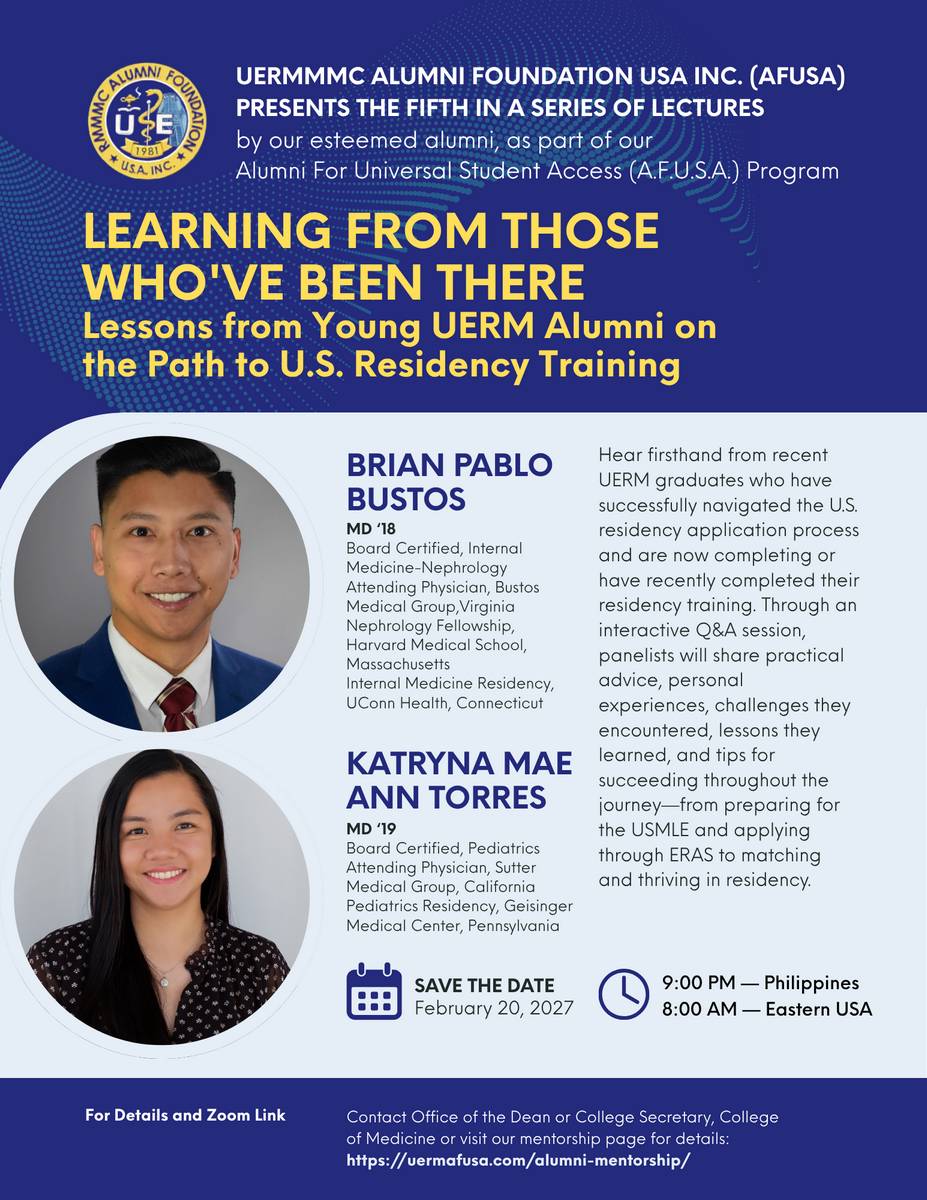
| Brian Pablo Bustos MD ’18 Board Certified Internal Medicine-Nephrology Attending Physician, Bustos Medical Group, Virginia Nephrology Fellowship, Harvard Medical School, Massachusetts Internal Medicine Residency, University of Connecticut Health Virginia |
| Katryna Mae Ann Torres MD’19 Board Certified Pediatrics Attending Physician, Sutter Medical Group, California Pediatrics Residency, Geisinger Medical Center Pennsylvania |
| Emilio C. Tayag MD ’90 Board Certified Neurology and Neurosurgery Clinical Instructor, Neurology and Neurosurgery Residency Programs Desert Regional, Medical Center, Palm Springs, CA Asst. Professor, Neurology and Neurosurgery California University of Science & Medicine, School of Medicine San Bernardino, CA Neurology and Neurosurgery, Arrowhead Neurosurgical Medical Group California |
| Pauline J. Jose MD ’85 Board Certified Family Medicine and Wellness & Functional Medicine Certified Holistic Coach California |
| Pamela Rama-de Padua MD ’88 FACC Board Certified in Cardiovascular Disease Chief of Cardiology, Baptist Medical Center Beaches Chairperson of the Florida Obesity Society Jacksonville, Florida |
| Nardo Buena MD ’75 Board Certified Family Medicine California |
| Ariel S. Torres MD ’93 RN SCOPE Specializes in Weight Loss, Non-invasive Aesthetic Slimming and Body Figure Shaping Center Medical Doctor, Marie France Bodyline International Philippines |
| Nikki Gavino-Collins MD ’01 Former Faculty, Dept of Preventive & Community Medicine, UERM and Ateneo Masters in Public Health Family Medicine Michigan |
| Maria Alyssa Policarpio MD ’19 Internal Medicine, Jacobi Medical Center in New York Fellowship in Infectious Disease Mayo Clinic Minnesota |
| Teresita Amay MD ’85 Child, Adolescent & Adult Psychiatry Diplomate , American Board of Psychiatry and Neurology California |
| Alfiniano Pintor MD ‘96 Clinical Professor Dept of Medicine Lewis Katz School of Medicine at Temple University Hospitalist , St. Luke’s University Hospital Pennsylvania |
| Justin Michael Quion MD ‘22 Chief Resident, Internal Medicine and Pediatrics Atrium Health Navicent Georgia |
| Alyssa Nicole Bautista-Quion MD ‘22 Chief Resident, Internal Medicine and Pediatrics Atrium Health Navicent Georgia |